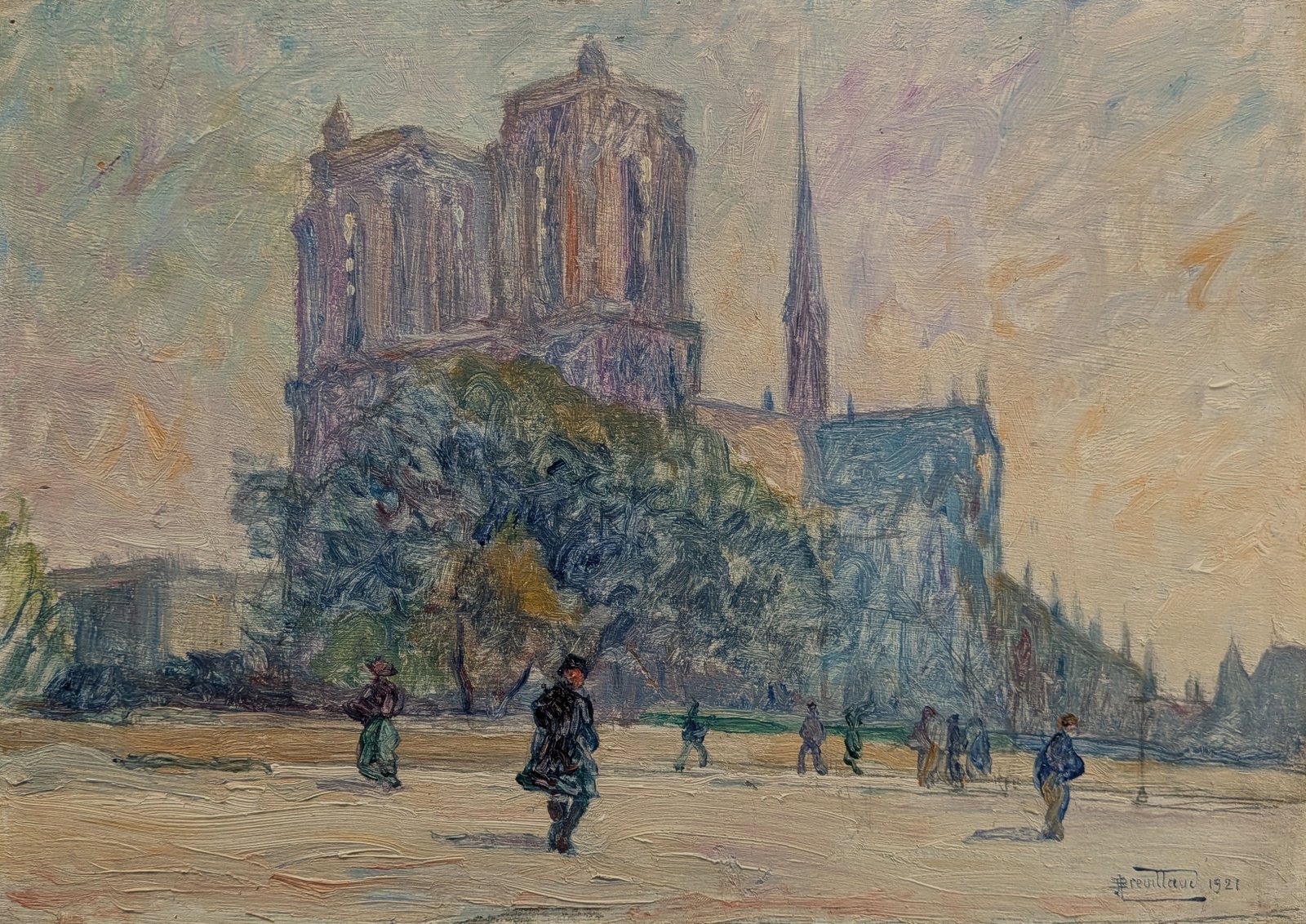
Technical information
- Title : Notre-Dame de Paris
- Date : 1921
- Technique : Oil on wood panel
- Dimensions : 24 × 33 cm
- Location : Private collection*
- Signature : signed and dated 21 lower right
Biographical / historical context
This small oil on wood panel constitutes, in the current state of the corpus, the earliest known work by André Breuillaud. Dated 1921, it still belongs to a phase of training and of consolidation of the artist’s gaze, before the zone landscapes and popular scenes that would mark the mid-1920s. The choice of Notre-Dame de Paris places the young artist within a tradition of urban and monumental views, in which the architectural motif serves to test the construction of masses, atmospheric depth and the human presence within the space of the city.
The inscription on the reverse gives the work a particular documentary and personal dimension: “À Monsieur le curé de Saint Germain Beaupré Creuse en étroite communion spirituelle”. Written in graphite pencil, this dedication links the panel to an identified recipient and introduces a spiritual tone that resonates with the chosen subject. It also confirms the importance Breuillaud attached, from his earliest years, to the handwritten identification of his works.
Through its small format, subject, date and pictorial treatment, this work may be compared with the large canvas Notre-Dame de Paris, executed in the same year and acquired by the French State in 1922. Although it is not possible to assert with certainty that it served a preparatory function, the panel may be understood as a small-format version, a completed study, or an initial formulation intended to establish the motif before its development in a more ambitious format.
Formal / stylistic description
The composition adopts a tightly framed horizontal format. The mass of Notre-Dame dominates the upper part of the image: the two towers rise in grey and pinkish light, while the spire, thinner and darker, stands out on the right. The architecture is not described with topographical precision; rather, it is absorbed into a misty atmosphere, built from muted values in which violets, bluish greys and browns merge with the sky.
In the foreground, the open space of the square is crossed by a few small figures. Their minute scale accentuates the monumentality of the cathedral while animating the scene with a discreet sense of movement. These swiftly indicated silhouettes introduce a note of everyday life: Breuillaud does not paint only a monument, but an inhabited place, caught in the light of late afternoon or of a misty morning.
The pictorial matter is laid down in visible, nervous and supple touches, with striations that follow the movements of the sky, the ground and the architectural volumes. The wood panel favours a dense, slightly glossy surface, where the brushwork catches the light. The very restrained palette gives priority to warm greys, mauves, muted blues and a few ochre accents. This chromatic restraint gives the work a meditative, almost recollected character, in keeping with the subject and with the dedication on the reverse.
Comparative analysis / related works
The comparison with AB-PF-1921-003, Notre-Dame de Paris, an oil on canvas measuring 60 × 70 cm and acquired by the French State, is essential. The two works share the same subject, the same date and a closely related conception: in both, the cathedral appears as a vertical mass immersed in diffuse light, while the figures in the foreground provide a human counterpoint and a measure of scale. The small panel, however, condenses the motif into a more intimate and tactile formulation: the brushwork appears tighter, the material more concentrated, and the framing reinforces the density of the scene.
The large canvas intended for the State develops the subject in a broader format, with wider atmospheric breathing; the panel functions instead as a concentrated image, almost like a painted note. This relationship permits the hypothesis of a preparatory or parallel work, without reducing the panel to a mere sketch: it possesses real pictorial autonomy through its balanced composition, the quality of its matter and the intensity of its atmosphere.
Another element strengthens the interest of this comparison: these two works are, to date, the only known examples bearing this type of signature on the front. By contrast, the signature associated with the dedication on the reverse already corresponds to the one Breuillaud would use durably to authenticate his works. This dual evidence makes the panel a transitional document: it bears witness to a moment when the artist was still seeking his public presentation, while already establishing the handwritten signs of his identity as author.
Justification of dating and attribution
The dating to 1921 is confirmed by the signature and date visible at the lower right. It is also consistent with the facture of an early work: a still descriptive construction, an atmosphere inherited from late Impressionism, a sober palette and a search for solidity in the architectural masses. The work precedes the more assertive simplifications and social tensions of the ZM period; it still belongs to a very controlled moment of apprenticeship, in which Breuillaud observes the city through a major patrimonial motif.
The attribution to André Breuillaud is supported by the signature on the front, by the handwritten dedication on the reverse and by the comparison with the large 1921 version acquired by the French State. The very early character of the work explains certain particularities, notably the front signature, which differs from the form that would subsequently become the norm within his catalogue. Taken together, the material, stylistic and documentary elements allow the work to be retained as a major milestone in the artist’s beginnings.
Provenance / exhibitions / publications
Current location: private collection*.
Inscription on the reverse: handwritten dedication in graphite pencil, “À Monsieur le curé de Saint Germain Beaupré Creuse en étroite communion spirituelle”.
Work to be compared with AB-PF-1921-003, Notre-Dame de Paris, oil on canvas, 60 × 70 cm, acquired by the French State in 1922, inventory FNAC 7621, on deposit at the Centre Hospitalier Régional de Poitiers since 14 February 1922.
© Bruno Restout - Catalogue raisonné André Breuillaud