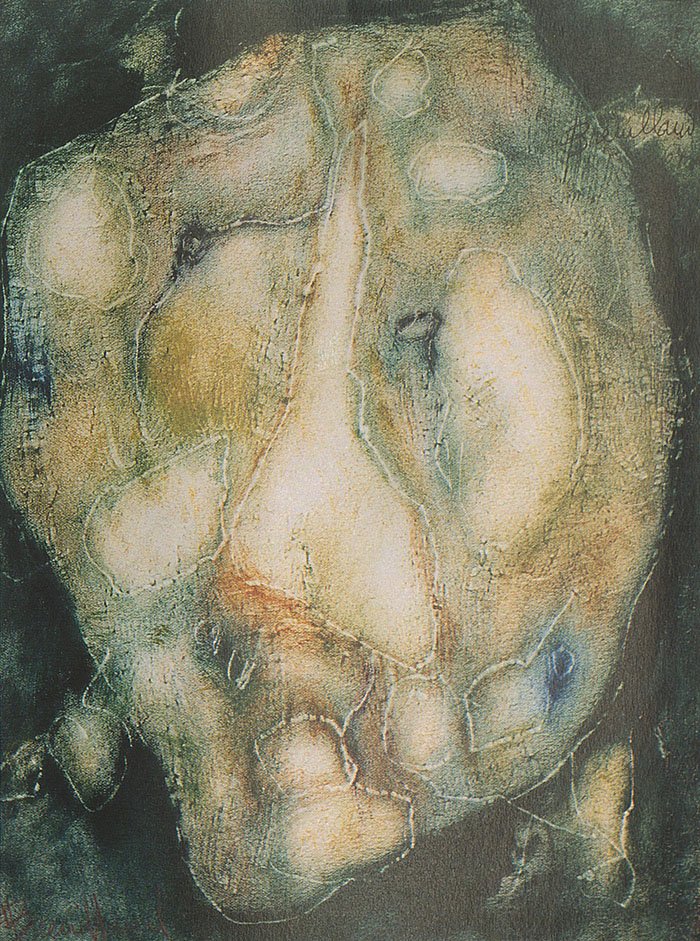
Technical information
- Title : The Monster (I)
- Date : c. 1964
- Technique : Oil on paper
- Dimensions : 32 × 25 cm
- Location : Private collection
Biographical / historical context
This work belongs to the group of compositions in which Breuillaud concentrates the figure into an isolated presence, without a setting or identifiable action. Comparison with the 1963 face, AB-63A-1963-008, sheds light on its organisation: facial features do not disappear, but are transformed into reliefs, swellings and hollows within an irregular envelope.
The identification of the medium as oil on paper clarifies the material nature of this exploration. This is a painting in which the arrangement of colour and the fine lines work together to construct volume, rather than a pastel or a painting on panel. The paper support does not, however, in itself establish the work's status as a study: the coherence of the composition allows it to be considered as a work in its own right, without reducing it to a preparatory exercise.
The dimensions of 32 × 25 cm, attested by the reference to the 1992 Philippon catalogue provided in the documentation, distinguish this work from The Monster (II), AB-64C-1964-006, also executed in oil on paper, but measuring 65 × 50 cm. Their affinities must now be considered in the light of this difference in scale.
Formal / stylistic description
A large vertical form occupies almost the entire surface. Its rounded but irregular contour stands out against a very dark green background. The central envelope narrows in places, extends downwards and cannot be reduced to a geometric oval. The absence of a horizon or supporting plane reinforces its autonomy within the image.
An elongated light-coloured projection in the middle section is one of the composition's principal articulations. Its shape suggests an enlarged nose, widening and bending at its base. Around this axis are distributed darker areas, swellings and luminous zones that may be read as regions of a profoundly transformed face.
This facial reading does not, however, rest on regular symmetry. The lateral volumes differ in their extent and intensity. The indications of eyes and mouth are less clearly defined than in AB-63A-1963-008. The figure remains recognisable through certain features, while exceeding the proportions of an ordinary head.
The palette combines beiges, pale ochres, greys and bluish greens. The lightest areas do not describe uniform illumination: they emphasise particular swellings and create transitions between the different parts of the form. Conversely, the dark accents create local recesses, giving depth to a composition without descriptive perspective.
A network of fine lines, at times light and at times darkened, runs across the surface. These marks follow certain volumes, interrupt others, or establish correspondences between distant regions. They do more than describe an external outline; they make an internal organisation perceptible.
Variations in the density of the paint and visible irregularities contribute to this sense of presence. Their appearance does not, however, allow the precise methods of execution to be established from a photograph alone. Effects suggestive of rubbing, removal or renewed linear work do not constitute proof of the use of any particular tool.
The work thus sustains a tension between unity and deformation. A single presence asserts itself, yet its parts cannot be fully ordered according to a familiar anatomical scheme. The title The Monster (I) accompanies this strangeness without requiring a pathological interpretation or a narrative of threat.
Comparative analysis / related works
Comparison with The Monster (II), AB-64C-1964-006, rests on several shared characteristics: oil on paper, a vertical format, a light-coloured mass isolated against a dark ground, a network of fine lines, and an articulation between apparent reliefs and recessed areas.
The difference in dimensions is essential. The second work measures 65 × 50 cm, approximately twice the size in each direction and slightly more than four times the surface area of the first. Their similar proportions facilitate comparison, but should not conceal the difference in physical presence. Reproductions displayed at the same height can make the two works appear artificially equivalent.
In The Monster (I), the ochre and greenish modulations lend the figure a relatively dense continuity. The long central relief strongly guides the reading of the image. In The Monster (II), the paler mass extends within a broader, more irregular contour, while several dark-rimmed openings redistribute the points of attention. It is therefore not simply an enlargement of the same composition.
Comparison with AB-63A-1963-008 helps clarify the role of the face. In that 1963 oil on canvas, the two asymmetrical eyes and the nose form clearly established points of reference. In The Monster (I), these relationships are more fully absorbed into the volumes: facial features tend to become the reliefs of a form whose identity remains fluid.
AB-62A-1962-004 provides another point of comparison. Its yellow field leaves the signs widely dispersed, whereas here the dark ground and the contour bring the elements together into a distinct presence. This difference concerns the organisation of the image; it does not suffice to establish an inevitable progression between the works.
Neither the small format nor the paper support justifies treating The Monster (I) as a preparatory study for The Monster (II). Their order of execution, and the possible existence of a shared project, remain to be documented.
Justification of dating and attribution
The dating to c. 1964 is retained in accordance with the classification of the catalogue raisonné. The reference to the 1992 Philippon catalogue, cited as evidence for the dimensions of 32 × 25 cm, does not, on the basis of the information supplied, allow the date to be established more precisely.
The signature visible in the upper-right part of the reproduction, together with the formal coherence of the work in relation to the comparable pieces, forms part of the evidence for attribution. The relationships between the light-coloured areas, the darkened hollows and the linear network make this comparison particularly relevant. A signature incorporated at this level of the work is, to date, exceptional in Breuillaud's oeuvre.
The medium is recorded as oil on paper, in accordance with the documentary verification. The type of paper, any preparation it may have received, and the sequence of pictorial interventions cannot be established from the available reproductions. The dating should not be inferred from an assumed automatic progression in the texture or thickness of the paint.
Provenance / exhibitions / publications
Private collection.
Bibliographic reference: Philippon catalogue, 1992, cited in the documentation as evidence for the dimensions of 32 × 25 cm.
© Bruno Restout — Catalogue raisonné André Breuillaud